



The hardest part of a 9pm pet problem is rarely the problem itself. It is the not knowing. Something is off, we are closed, and you are deciding whether this is a drive across town or a phone call in the morning.
We hear about those nights constantly, usually the next day. Owners who waited when they should not have were rarely careless. They simply had no clear line to measure the symptom against.
Here is the line. Three tiers, and the signs that put your pet in each one. One rule sits above all three: if you are genuinely unsure, call. An emergency hospital will talk symptoms through over the phone, and that call costs nothing.
Tier 1: Go to an emergency hospital now
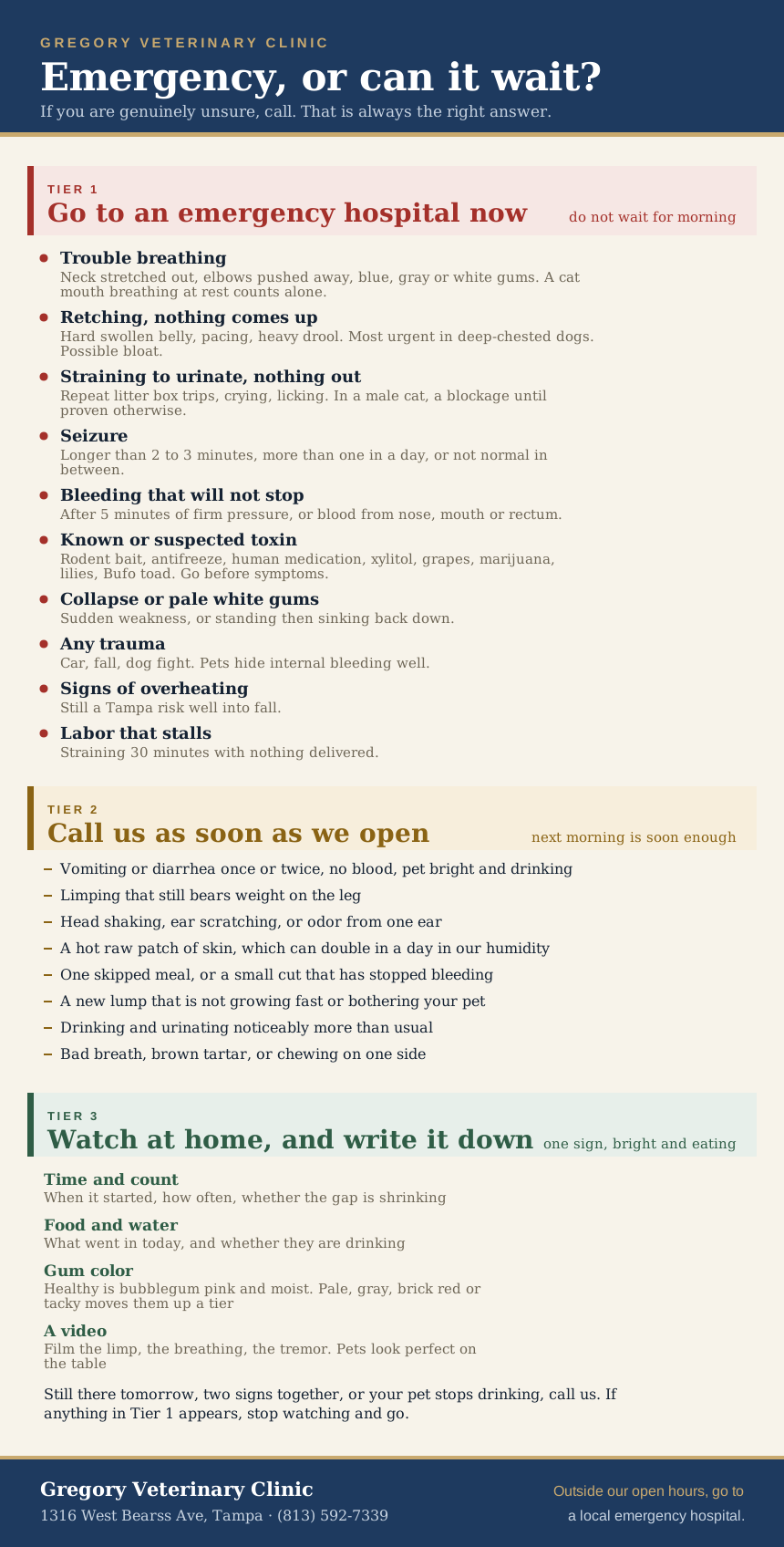
These do not wait. Head to the nearest emergency veterinary hospital and call on the way, so their team is ready when you pull in.
- Trouble breathing. A stretched out neck, elbows held away from the body, a heaving belly, or gums that look blue, gray, or white. A cat breathing with its mouth open at rest counts on its own.
- Retching with nothing coming up, or a hard, swollen belly. Most urgent in deep-chested dogs: Great Danes, Boxers, German Shepherds, Weimaraners, standard poodles. Add pacing and heavy drool and this may be bloat, where hours change the outcome.
- Straining to urinate with nothing coming out. Repeat trips to the litter box, crying, licking at the back end. In a male cat this is a blockage until proven otherwise, and it can turn critical in under a day.
- A seizure lasting longer than two to three minutes, more than one in a day, or a pet who does not return to normal in between.
- Bleeding that will not stop after five minutes of firm pressure, or blood from the nose, mouth, or rectum.
- A known or suspected toxin. Rodent bait, antifreeze, human medication, xylitol, grapes or raisins, marijuana, lilies for cats, a Bufo toad in the yard. Go before symptoms start. Treatment is far easier in hour one than hour six.
- Collapse, sudden weakness, or pale white gums, including a pet who stands and then sinks back down.
- Any trauma. Hit by a car, a fall, a dog fight. Pets hide internal bleeding well, and a dog who walks away from a car is not fine.
- Signs of overheating, still a risk in Tampa well into fall. Our guide to heatstroke in Florida pets covers what to do while you drive.
- Labor that stalls, meaning a dog or cat straining 30 minutes with nothing delivered.
Tier 2: Call us as soon as we open
These need a veterinarian, but not a midnight drive. Note what you saw, keep your pet quiet, and call us at (813) 592-7339 as soon as we are open. If anything here worsens sharply overnight, treat it as Tier 1.
- Vomiting or diarrhea once or twice, no blood, in a pet who is bright and drinking
- Limping that still bears weight on the leg
- Head shaking, ear scratching, or a strong odor from one ear
- A hot, raw patch of skin, which in our humidity can double in a day
- One skipped meal, or a small cut that has stopped bleeding, in a pet with normal energy
- A new lump that is not growing fast or bothering your pet
- Drinking and urinating noticeably more than usual this week
- Bad breath, brown tartar, or chewing on one side of the mouth
Tier 3: Watch at home and take notes
Some things really do settle on their own, and overnight your job is to observe carefully rather than worry vaguely. Monitor at home for one soft stool with normal energy afterward, a single vomit with grass in it followed by a normal meal, occasional sneezing with a good appetite, a mild limp that loosens with rest, or extra scratching with no redness or smell.
What to write down:
- Time and count. When it started, how often, and whether the gap between episodes is shrinking.
- Food and water. What went in today, and whether they are drinking.
- Gum color. Lift the lip. Healthy gums are bubblegum pink and moist. Pale, gray, brick red, or tacky gums move your pet up a tier.
- A video. Film the limp, the breathing, or the tremor. Pets look perfect on the exam table, so the clip often tells us more than the visit.
If a Tier 3 sign is still there the next day, if two show up together, or if your pet stops drinking, call us. If anything from Tier 1 appears, stop watching and go.
What Tampa owners should set up tonight
Put the closest emergency veterinary hospital in your phone now, because searching for one while a pet is struggling is its own kind of awful. Then photograph your pet's medication labels, since any team treating your pet will ask for them.
Carrollwood also hands us local hazards. Bufo toads are active most of the year here, not only in summer, and a dog who mouths one needs its gums rinsed sideways with a hose on the way in. More are in our guide to hidden backyard dangers for Carrollwood pets.
Frequently asked questions
Is a cat breathing with its mouth open always an emergency?Yes. Cats do not pant to cool off the way dogs do. In a resting cat it often means fluid around the lungs, asthma, or heart disease, and needs care immediately.
My pet ate something toxic but seems fine. Can I wait?No. Xylitol, antifreeze, and rodent bait show no signs until the damage is underway. Call an emergency hospital or a poison control line and bring the packaging. Do not make your pet vomit unless a veterinarian tells you to, since some substances do more damage coming back up.
What is the difference between an emergency hospital and our clinic?An emergency hospital is staffed to take critical patients overnight and on weekends, with the people and equipment to stabilize a pet at 3am. We handle preventive and routine care, we treat urgent problems during our open hours, and we refer complicated cases to trusted veterinary specialists. Send us the records afterward so we can pick up the follow up.
How do I know if my dog is bloating?Repeated attempts to vomit that bring up little or nothing, a belly that feels tight or looks swollen behind the ribs, drooling, and an inability to settle. Deep chested breeds carry the highest risk.
The short version
- Breathing trouble, bloat signs, a blocked cat, seizures, uncontrolled bleeding, toxins, collapse, and trauma mean go now.
- Mild vomiting, a weight bearing limp, ear trouble, skin sores, and new lumps mean call in the morning.
- One symptom in a bright, eating, drinking pet can be watched at home with notes and a video.
- Unsure at 9pm is a reason to call, never a reason to wait.
If your pet had a rough night, or you want a plan before the next one, call us at (813) 592-7339 or request an appointment. We would far rather see you for a follow up than hear that you spent the night deciding alone.